
 Log In
LeadTruffle Insights
Thumbtack and Google LSA: Real Reply and Conversion Rates
See Thumbtack and Google LSA reply rates, customer counts, and CRM-checked conversions from anonymized service businesses. Compare the numbers in this study.
Quick Answer
tl;dr: In three selected Thumbtack accounts using LeadTruffle, 41.6% to 60.7% of customers replied after the business answered. Three Google LSA accounts recorded 63.1% to 74.0%. Among customers who replied, verified invoice conversion was 11.2% for one Thumbtack plumbing company and 8.1% to 16.8% for the three LSA companies. These are observed customer examples, not industry averages or a promise of the same results.
You paid for the lead. You answered. Then nothing.
Some business owners we’ve spoken with report getting a customer reply on roughly 30% of their Thumbtack leads, with about 5% of all leads becoming jobs. Those figures come from customer conversations. We haven’t independently audited them as an industry benchmark or as the before-period for the accounts below.
Our aim is to help businesses get more of those customers talking, often targeting a 50% to 60% reply rate. Going from 30 replies to 50 or 60 out of 100 leads would mean 67% to 100% more conversations. This study checks what happened in selected accounts using LeadTruffle; it does not establish that every business will double its results.
We reviewed saved conversations and connected CRM records on October 6, 2026. Company names are replaced with labels such as “Plumbing company 1.” The same label means the same business throughout this article.
What the percentages mean
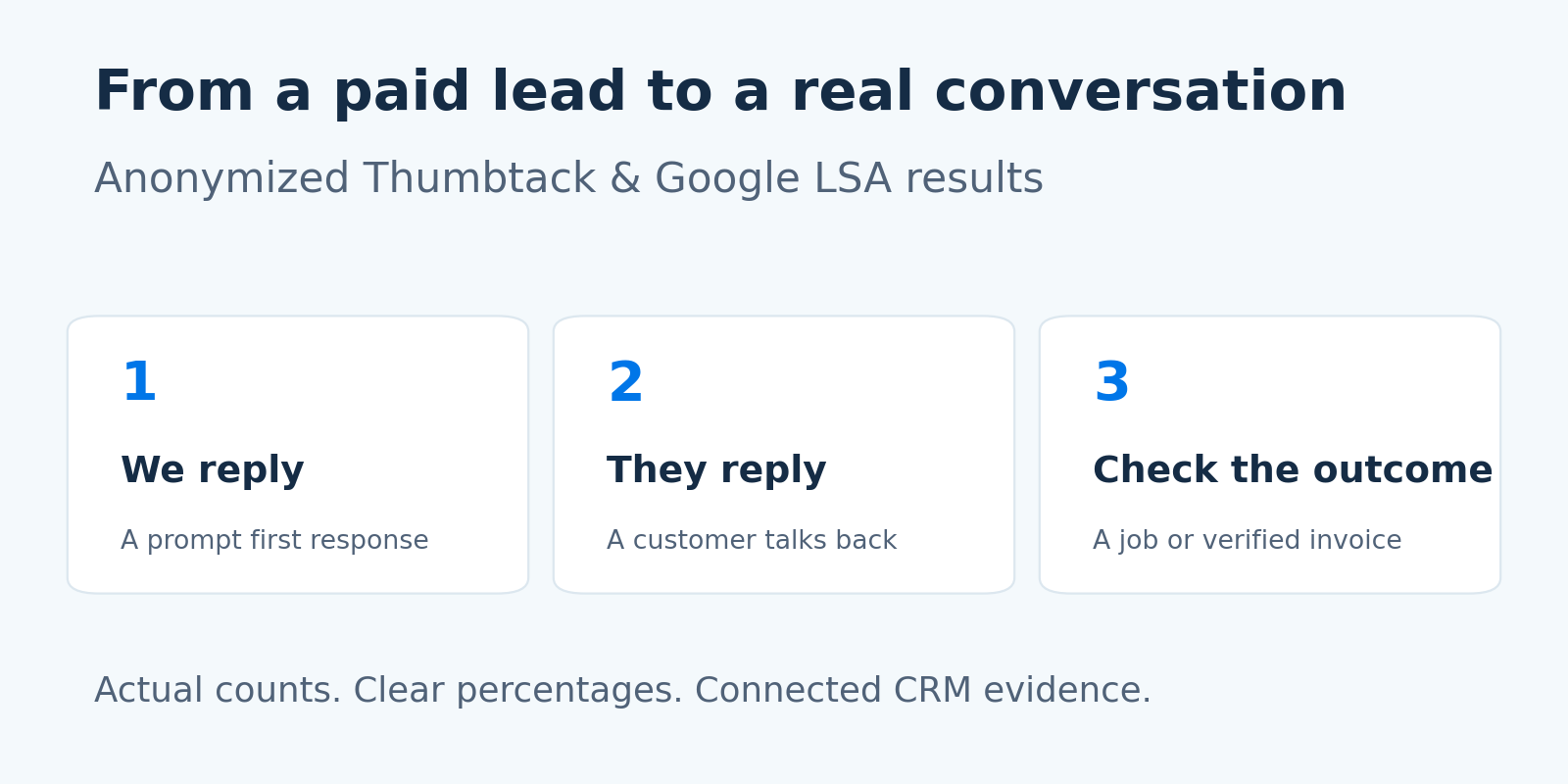
We followed three steps, separately for each lead source:
- We replied. The business sent its first response through LeadTruffle within 24 hours.
- The customer replied. The customer sent another message within seven days of that response. Their opening request doesn’t count.
- We checked the outcome. We looked for a qualifying invoice or completed job in the connected CRM.
Customer reply rate = customers who replied ÷ inquiries we answered.
Conversion among replies = replied inquiries with a verified invoice or stated job outcome ÷ customers who replied.
Each inquiry counts once, even if it produces several invoices. “Customers” is shorthand here for customer inquiries; one person could make more than one inquiry.
Thumbtack reply rates: two accounts near 60%
Here is the full Thumbtack funnel for three businesses using LeadTruffle:
| Business | We replied to | Customers replied | Reply rate | Replied inquiries with a CRM outcome | Conversion among replies |
|---|---|---|---|---|---|
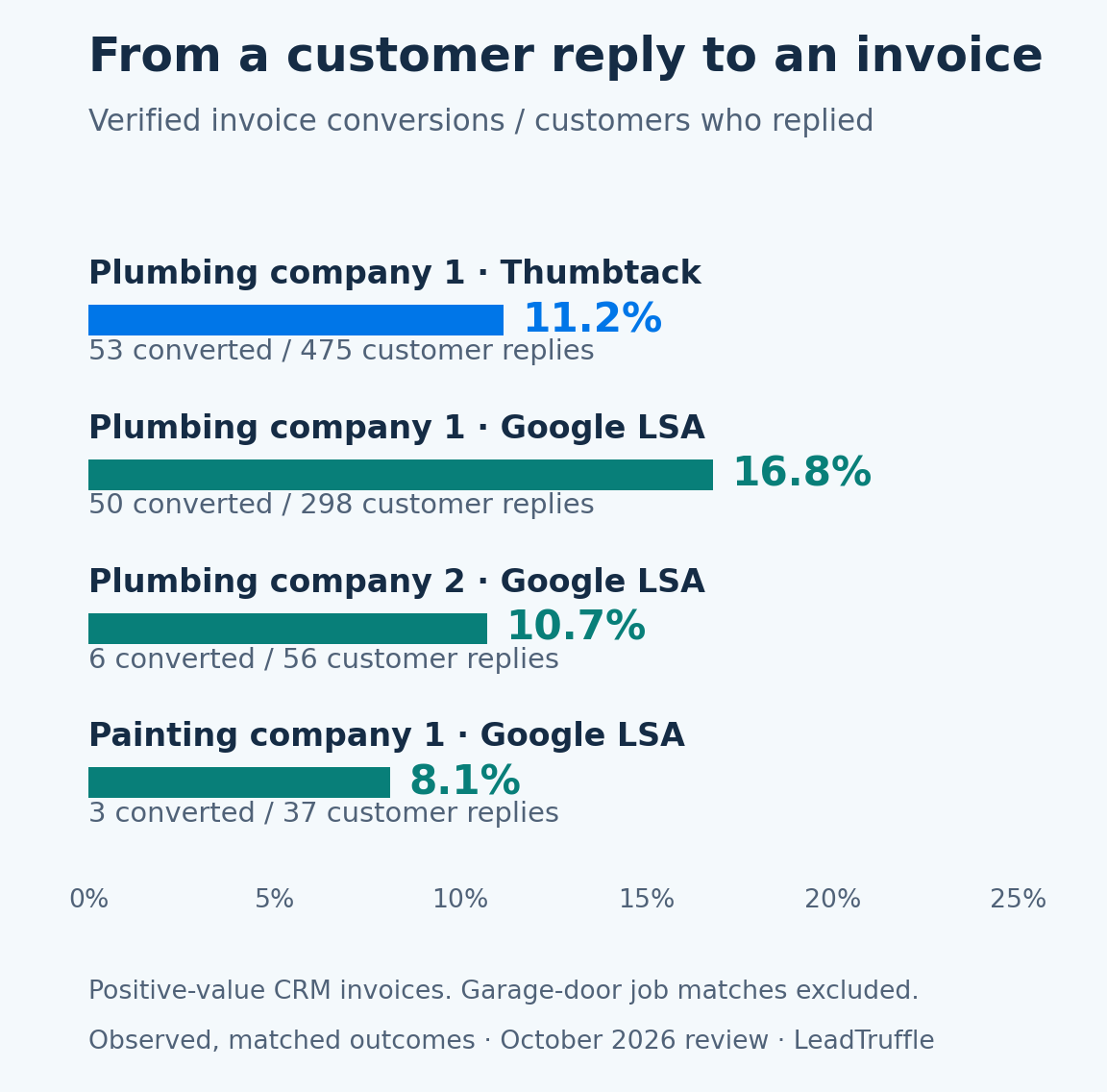
| Plumbing company 1 | 782 | 475 | 60.7% | 53 with verified invoices | 11.2% |
| Garage door company 1 | 469 | 195 | 41.6% | 18 with matched completed jobs* | 9.2%* |
| Garage door company 2 | 144 | 83 | 57.6% | 7 with matched completed jobs* | 8.4%* |
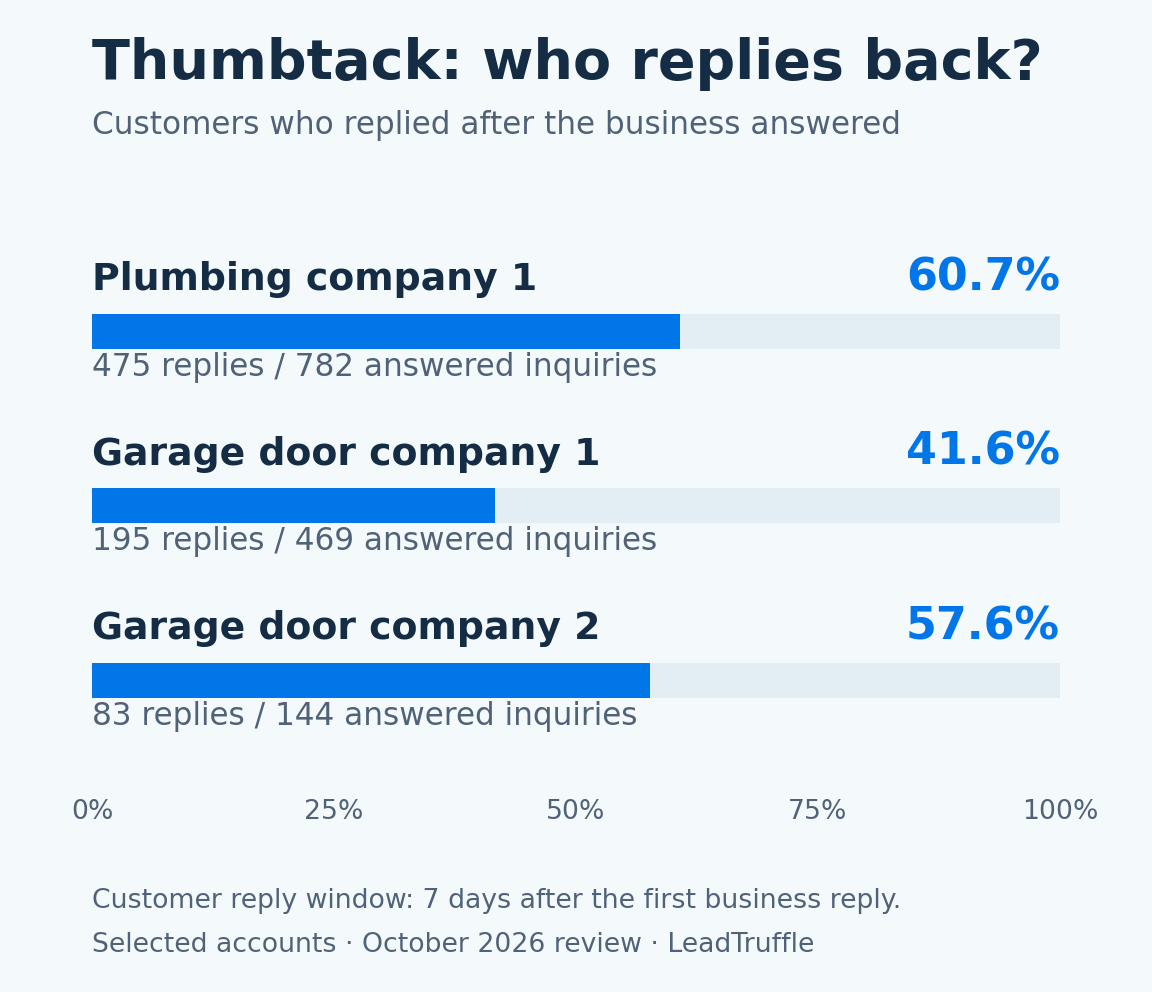
Two accounts reached 57.6% and 60.7%. The third reached 41.6%, so the results weren’t identical across businesses. The two higher results are close to twice the 30% starting point some owners reported, but these are different businesses rather than a measured before-and-after comparison.
For Plumbing company 1, the story is straightforward: 782 answered inquiries → 475 customer replies → 53 inquiries with verified invoices. Of those 475 customers who replied, 52 had at least one paid invoice, a 10.9% paid-invoice conversion rate.
The median first business reply was about 30 to 31 seconds in all three accounts, measured from the recorded Thumbtack inquiry time. We did not separately establish that every Thumbtack response was AI rather than a team member replying through LeadTruffle.
The garage-door results use completed, positive-value Workiz jobs, not verified invoice records. Their matching is provisional: Garage door company 1 had one converted inquiry matched by a stored CRM ID and 17 by exact contact information plus a Thumbtack source label. Company 2 had six ID matches and one contact match. A zero job balance alone does not prove that an invoice was paid.
Google LSA reply rates: 63% to 74% in these accounts
We ran the same funnel for Google LSA message leads handled through LeadTruffle’s email responder. These results exclude LSA phone calls and imported historical leads that LeadTruffle did not handle.
Google supports replying to LSA message leads through its email or SMS notifications. In this study, we required customer messages to come from the inquiry’s Google reply address. Staff forwards did not count as customer replies.
| Business | We replied to | Customers replied | Reply rate | Replied inquiries with verified paid invoices | Conversion among replies |
|---|---|---|---|---|---|
| Plumbing company 1 | 472 | 298 | 63.1% | 50 | 16.8% |
| Plumbing company 2 | 80 | 56 | 70.0% | 6 | 10.7% |
| Painting company 1 | 50 | 37 | 74.0% | 3 | 8.1% |
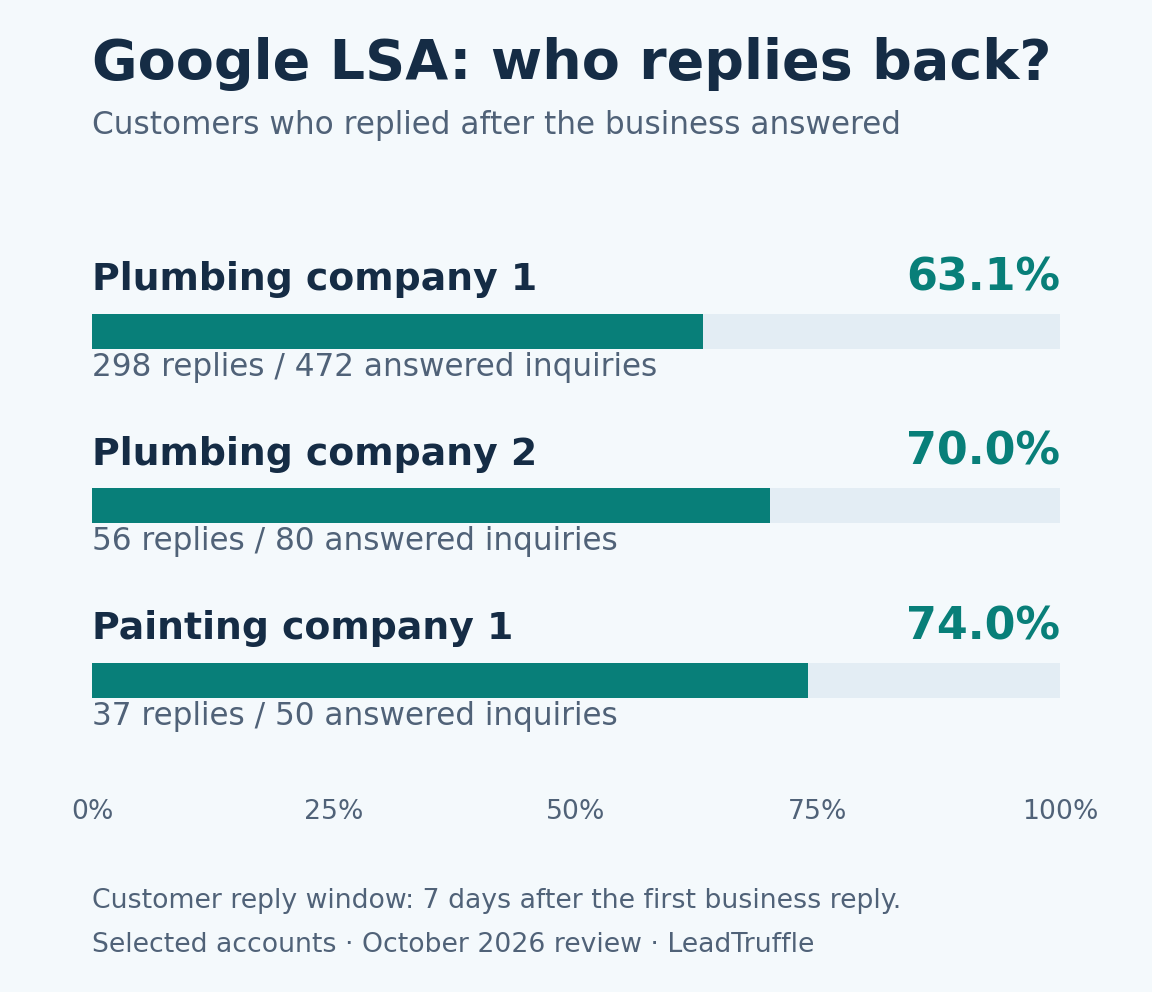
Plumbing company 1 gives us the largest invoice-backed LSA example: 472 answered inquiries → 298 customer replies → 50 inquiries with verified paid invoices. About one in six customers who replied had a paid invoice we could verify.
The smaller accounts also produced paid work, but six and three conversions are still small samples. We wouldn’t use them to promise a result for every plumber or painter.
All 602 first business replies in this LSA table had recorded AI attribution and a delivered status. Their median response times were 12.1 seconds, 9.7 seconds and 8.9 seconds, respectively, after LeadTruffle received the email. That clock starts later than Google’s original inquiry time, so it should not be directly compared with the Thumbtack timing above.
Which conversations became invoices?
This chart includes only the accounts with verified invoice outcomes. Each percentage uses the customers who replied as its starting point.
A moving company’s Google LSA response improvement
We also checked a moving company’s Google-recorded message history around its first recorded LeadTruffle use. This is a separate before-and-after response study.
| Measure | Before: July 22–August 20 | After: August 22–September 20 |
|---|---|---|
| Google LSA message inquiries | 415 | 381 |
| Inquiries the business answered within 24 hours | 357 | 381 |
| Business reply coverage | 86.0% | 100% |
| Median first business response | 17.8 minutes | 33 seconds |
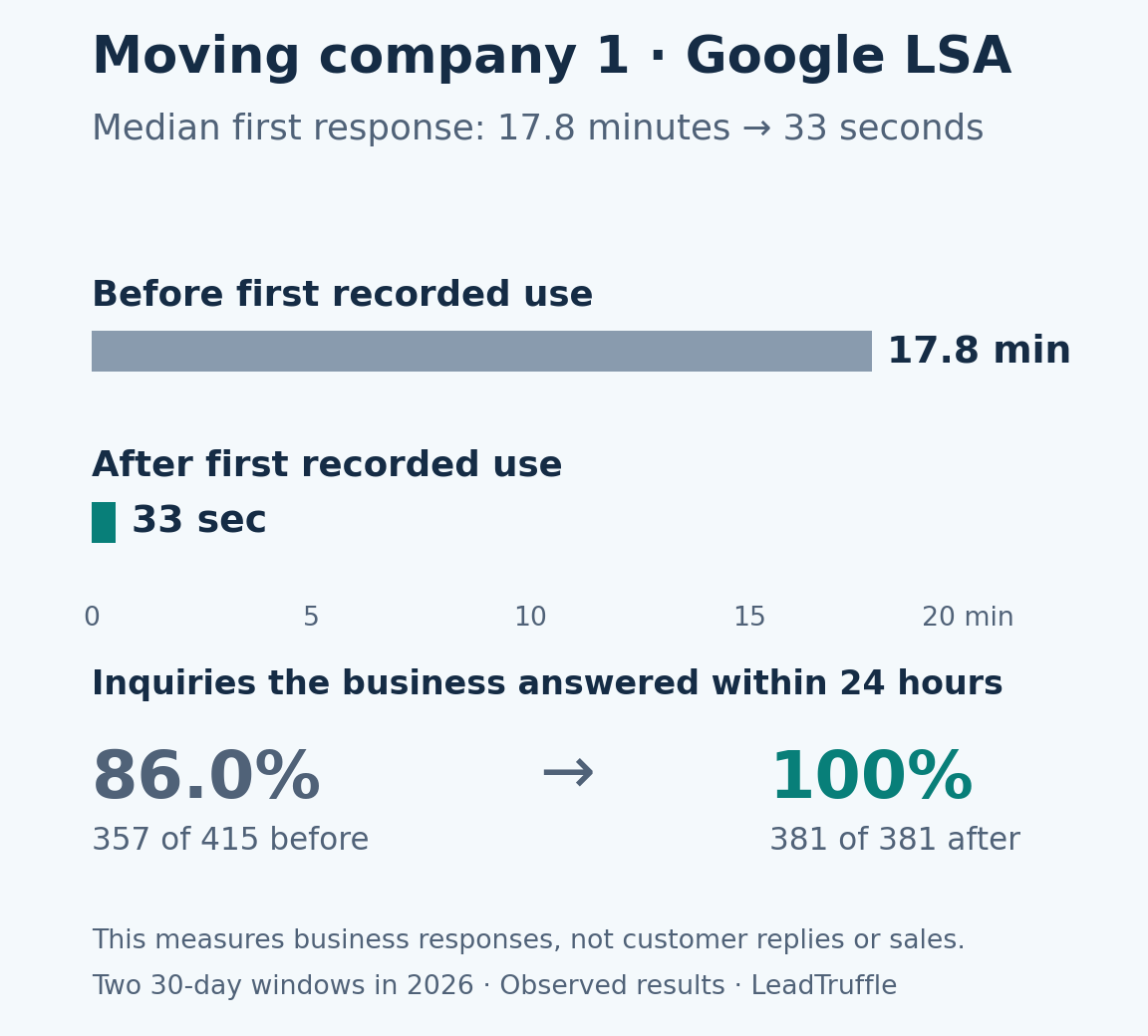
The median wait fell by about 97%. Business reply coverage increased by 14 percentage points. In the earlier period, 58 inquiries had no recorded business reply within 24 hours; in the later period, every inquiry had one.
This measures how quickly and consistently the business answered, rather than how many customers replied back. The windows surround first recorded use; the exact activation date still needs confirmation with the business. Other changes during those weeks may also have affected the result.
We found more completed-move matches in the later period, but we could identify far more customers in that period too. That prevents a reliable sales-lift comparison. The response-speed and coverage figures are the findings we can show clearly.
How to compare these results with a 5% close rate
A 5% close rate across all leads and an 11.2% conversion rate among customers who replied answer different questions.
Take a simple illustration:
| Step | Example starting point | Example with more replies |
|---|---|---|
| Leads received and answered | 100 | 100 |
| Customers who reply | 30 | 60 |
| Share of replying customers who become jobs | 1 in 6 | 1 in 6 |
| Jobs won | 5 | 10 |
This is arithmetic, not an observed customer result or a forecast. It holds the close rate among replying customers steady. In practice, more replies could include customers who are harder to close, and staffing, pricing and scheduling still matter.
It explains why reply rate matters: more conversations give your team more opportunities to quote and book. You still need to track what happens after the conversation starts.
How we checked the numbers
The main account samples include inquiries received before September 6, with CRM outcomes checked on October 6. Every inquiry had at least 30 days to develop; older inquiries had longer. The periods differ:
| Business | Thumbtack inquiry period, 2026 | Google LSA inquiry period, 2026 |
|---|---|---|
| Plumbing company 1 | June 18–September 5 | March 4–September 5 |
| Garage door company 1 | July 30–September 5 | Not included |
| Garage door company 2 | March 14–September 5 | Not included |
| Plumbing company 2 | Not included | April 22–September 2 |
| Painting company 1 | Not included | May 2–September 4 |
We checked positive invoice amounts, invoice status, the connected CRM account, job dates and competing inquiry attribution. Zero-dollar and voided invoices were excluded, even if a zero-dollar record said “paid.” A paid invoice also had to show zero due.
We removed duplicate threads and kept the lead sources separate. For Plumbing company 2 on LSA, excluding staff messages removed six apparent customer responders. The corrected count is 56, as shown above.
The accounts were selected for useful lead volume and accessible CRM records. They are not a random industry sample. Missing invoice matches remain unknown outcomes, so the tables show the conversions we could identify and verify. They do not establish every company’s complete close rate or additional revenue caused by LeadTruffle.
You can download the anonymized counts and definitions. No customer names, addresses, message contents, invoice IDs or account credentials are included.
What to track in your own business
Keep a separate three-number scorecard for Thumbtack, Google LSA and each other source:
Inquiries answered → customers who reply → verified jobs or invoices.
Check it weekly. If customers aren’t replying, review the speed and content of your first message. If they reply but don’t book, review your pricing, availability and follow-up. A booking and a paid invoice are different stages, so label whichever result you’re tracking.
LeadTruffle’s Thumbtack responder and Google LSA responder help your business answer, qualify and follow up with incoming message leads. Connected CRM records let you check what those conversations become.
See how LeadTruffle would handle your leads, and bring your current reply and close rates. That’s the starting point that matters for your business.