Log In

LeadTruffle Insights
Roofing Lead Generation: The Complete Guide for 2026
Learn how to generate exclusive roofing leads without paying for shared leads. Covers SEO, Google Ads, LSA, referrals, and why owning your lead flow beats buying from aggregators.
Short Answer
tl;dr: Roofing leads are expensive and competition is intense, so the winners own their lead flow instead of relying on shared leads. The best ROI comes from fast response times, high-intent channels like SEO and Google LSA, and a repeatable follow-up system. This guide breaks down lead costs by channel and shows how to build a more predictable pipeline in 2026.
Roofing lead generation costs more than almost any other home service category. Google Ads leads average $187 each for roofers - the highest of any trade analyzed. And that’s just the cost to get someone’s phone number. You still have to close them.
The U.S. roofing industry hit $76.4 billion in revenue in 2025, spread across roughly 100,000 businesses. That works out to about $764,000 per company on average, though most roofers fall well below that number. A handful of national companies pull the average up significantly.
Competition is brutal. Multiple contractors bid on the same jobs in the same neighborhoods. Homeowners have endless options. And the contractor who responds fastest usually wins - not the one with the best price or longest warranty.
This guide covers what actually works for roofing lead generation in 2026: which channels deliver the best ROI, what you should expect to pay, and why owning your lead flow beats buying shared leads from aggregators.
The Real Cost of Roofing Leads
Before spending money on marketing, you need to understand what leads actually cost and what they’re worth. Here’s the current data.
Cost Per Lead by Channel
| Channel | Cost Per Lead | Close Rate | Notes |
|---|---|---|---|
| Google PPC | $150-$200 | 20-40% | Highest CPL, high intent |
| Google LSA | $40-$100 | 25-35% | Pay per lead, not per click |
| Facebook/Instagram | $20-$80 | 15-25% | Lower intent, lower cost |
| Lead Aggregators | $50-$100 | 10-20% | Shared with 4-6 competitors |
| SEO/Organic | <$50 | 30-50% | Takes time, best long-term ROI |
| Referrals | ~$0 | 50%+ | Best conversion rate |
| Canvassing | $20-$50 | 15-30% | Depends on storm activity |
| Direct Mail | $20-$70 | 10-20% | Works for targeted neighborhoods |
The average roofing company closes about 27% of leads. Top performers hit 30-40%. Referral leads close above 50% because the trust is already built.
Customer acquisition cost across home improvement averages $610. Roofing tends to run higher because of the expensive ad keywords.
Exclusive vs Shared Leads
This is the most important distinction in roofing lead generation.
Exclusive leads come directly to you through your own marketing. Your website, your ads, your referrals. You’re not competing with other roofers in real-time for the same customer.
Shared leads get sold to 4-6 contractors simultaneously. Everyone calls at once. The homeowner gets overwhelmed with calls. Price usually wins, or whoever calls first.
The data is clear: exclusive leads convert at 3-5x higher rates than shared leads. A $150 exclusive lead that closes at 35% costs you about $428 per customer. A $75 shared lead that closes at 12% costs you $625 per customer - and you built nothing for your brand in the process.
Owned Channels: SEO and Website
Your website and Google Business Profile are assets you control. They cost money upfront but generate leads for years. This is where the best long-term ROI comes from.
Google Business Profile Optimization
Your Google Business Profile shows up in the Map Pack when someone searches “roofer near me.” For urgent needs like a leaking roof, this is often the first thing homeowners see.
To rank higher:
- Make sure your name, address, and phone number match everywhere online
- Add 15+ high-quality photos (completed roofs, your team at work, before/after shots)
- Get more Google reviews than your competitors
- Respond to every review, positive or negative
- Use Google Posts to share updates and promotions
- Add all your service categories (roof repair, replacement, gutters, etc.)
Reviews matter more than anything else in local SEO. Over 91% of homeowners read reviews before hiring a contractor, and 35% say reviews are the single most important factor in their decision.
Website SEO
Your website should rank for the searches your customers make. That means creating pages for each service and each location you serve.
Service pages: Create separate pages for roof replacement, roof repair, gutter installation, storm damage repair, and any other services you offer. A single “Services” page doesn’t rank for anything specific.
Location pages: If you serve multiple cities, create a page for each one. “Roof Repair in Austin” should be its own page targeting that keyword.
Blog content: Answer questions homeowners actually ask. “How much does a new roof cost?” “How do I know if I need a roof replacement?” “What does insurance cover for roof damage?” This content brings in people researching roofing - and some percentage will hire you.
One roofing company invested in SEO content for two years and saw 109% more traffic and 340% more leads. SEO takes time, but the results compound.
Technical basics:
- Mobile-friendly design (most searches happen on phones)
- Page load time under 3 seconds
- Clear call-to-action on every page (phone number, quote form)
- Schema markup so Google understands your business
Response Time on Website Leads
When someone fills out a form on your website, you have minutes - not hours - to respond.
Over 40% of roofing jobs go to the first contractor who responds. Contacting a lead within 5 minutes makes them 100x more likely to engage compared to waiting an hour. By the 6th contact attempt, you have a 90% chance of getting a response.
Set up instant notifications. Use automation to send an immediate text or email acknowledging their request. Then call within 5 minutes.
Paid Channels: Google Ads, LSA, and Social
Paid advertising gets you leads immediately while you build your organic presence. The key is knowing which platforms work best for roofing.
Google Search Ads (PPC)
Google Ads puts you at the top of search results for high-intent keywords like “roof replacement near me” or “emergency roof repair.”
The numbers:
- Average cost per click: $10-$12
- Average conversion rate: 5-6%
- Average cost per lead: $150-$200
Yes, it’s expensive. But someone searching “roof replacement” is probably ready to buy. A $180 lead that becomes a $12,000 job is money well spent - if your close rate supports it.
What works:
- Bid on high-intent keywords with location modifiers
- Geo-target only areas you serve
- Write ad copy that stands out (“50-Year Warranty,” “BBB A+ Rated,” “Free Estimates”)
- Send clicks to dedicated landing pages, not your homepage
- Use call extensions so people can tap to call
- Add negative keywords to filter out DIY searches
Track everything. Use call tracking numbers and conversion tracking so you know which keywords actually produce customers.
Google Local Services Ads (LSA)
Google LSA is the best-value paid channel for most roofers right now. These are the ads with the green “Google Guaranteed” checkmark at the very top of search results.
Why LSA works:
- You pay per lead, not per click (huge difference)
- Cost per lead typically runs $40-$100
- The Google Guaranteed badge builds instant trust
- Leads come as phone calls - high intent
- You can dispute invalid leads for refunds
To get started, you need to pass Google’s screening (background check, license verification). Then ranking depends heavily on your Google reviews and response rate.
Many roofers report LSA delivers their best ROI of any paid channel.
Facebook and Instagram Ads
Social ads cost less per lead than Google but require different expectations. People scrolling Facebook aren’t actively looking for a roofer. You’re interrupting them.
Average cost per lead: $20-$80 (significantly cheaper than search ads)
What works:
- Storm-triggered campaigns (“Hail storm in Westfield? Get a free roof inspection”)
- Before/after photos that stop the scroll
- Video content showing your team at work
- Retargeting people who visited your website
- Lead forms that capture info without leaving Facebook
Social leads tend to be colder. They might need more follow-up before they’re ready to buy. But at $40 per lead vs $180 on Google, you have room to nurture them.
Lead Aggregators: The Math Problem
HomeAdvisor, Angi, Thumbtack - these platforms spend huge money on advertising to attract homeowners, then sell those leads to contractors.
How it typically works:
- Homeowner fills out “I need a roofing quote”
- The platform sells that lead to 4-6 contractors at $50-$100 each
- Everyone calls at once
- Homeowner picks the cheapest or the fastest
The math usually doesn’t work. If you pay $75 for a shared lead and only close 1 in 8 (12.5% rate), your effective cost per customer is $600. On a $10,000 job with 40% gross margin, you’re spending 15% of your profit just on lead acquisition - and you built zero brand equity in the process.
When aggregators might make sense:
- You’re brand new and need any work to build reviews
- You have a crew sitting idle next week
- You’re testing a new market
When to avoid them:
- You have other lead sources working
- You’re trying to build long-term profitability
- You want to own your customer relationships
The industry consensus in 2026: aggregator leads should be a small supplement, not your main strategy. They’re like renting - you get one shot at a lead, nothing compounds over time.
Referrals and Relationships
The highest-converting leads come from referrals. Over 60% of roofing companies say at least a quarter of their business comes from referrals. For top performers, it’s 75%.
Referral leads close above 50% because the trust is pre-built. Someone’s friend vouched for you.
Building a Referral System
Don’t leave referrals to chance. Create a formal program:
- Offer a reward ($250 Visa card, discount on future service) for any referral that becomes a customer
- Ask every happy customer directly: “If you know anyone who needs roof work, we’d appreciate you mentioning us”
- Send follow-up emails at 30, 90, and 365 days asking for referrals
- Deliver the reward promptly - reinforces the behavior
Strategic Partnerships
Build relationships with people who see roofing needs:
Insurance agents: Many roofs get replaced through insurance claims after storms. If local agents trust you, they’ll recommend you to clients filing claims.
Real estate agents: Roof inspections happen on almost every home sale. Be the roofer agents call when inspections find problems.
Home inspectors: They find roof issues constantly. A referral relationship benefits both sides.
General contractors and remodelers: They often need roofing subcontractors for projects.
Yard Signs and Visibility
Every completed job should market the next one:
- Put a yard sign at every project (with homeowner permission)
- Branded trucks act as mobile billboards
- Neighbors see your work and remember your name
You can’t measure yard sign ROI directly, but contractors consistently report “I saw your sign down the street” as a lead source.
Storm Chasing and Canvassing
Roofing has always relied on door-to-door canvassing, especially after storms. In 2026, the most effective roofers combine traditional canvassing with digital tools.
Traditional Canvassing
After a hail or wind storm, conversion rates jump. Under normal conditions, maybe 1 in 10-15 doors produces an inspection appointment. After a storm, it can hit 30-50%.
What works:
- Branded uniforms and ID badges (homeowners are security-conscious)
- Lead with value: “We’re offering free storm damage inspections in this neighborhood”
- Use a mapping app to track which houses you’ve visited
- Follow up on everyone who said “maybe later”
Digital Door Knocking
This is the modern evolution: using data to target neighbors around your current jobs.
When you finish a roof on Maple Street, you can:
- Get a list of nearby homeowners’ contact info
- Send targeted outreach: “We just finished a roof for your neighbor at 123 Maple St. Many roofs in this area are 20+ years old - if you’d like a free inspection while we’re in the neighborhood, let us know.”
This combines proximity and social proof. The lead cost can be $3-$5 since you’re not paying for clicks.
Set up automations to trigger these campaigns whenever you mark a job complete.
Direct Mail
Yes, direct mail still works. Response rates often beat email (1-3.7% vs ~1%).
What works:
- Target specific neighborhoods: subdivisions with 18-year-old homes, areas recently hit by storms
- Strong offers: “Free Roof Inspection + 10% Off for New Customers”
- Eye-catching design with before/after photos
- QR codes linking to a landing page for scheduling
Typical costs: $0.50-$0.70 per piece mailed (design, printing, postage)
If you mail 5,000 postcards at $3,000 total and get 1.5% response (75 leads), then close 20 of them at $10,000 average, that’s $200,000 revenue for $3,000 spend.
Consistency helps. Mailing the same area 2-3 times builds recognition.
Speed to Lead: The Decisive Factor
We’ve mentioned this several times because it’s that important: the contractor who responds first usually wins the job.
The data:
- 40%+ of roofing jobs go to the first responder
- Leads contacted within 5 minutes are 100x more likely to respond vs waiting an hour
- By the 6th contact attempt, you have a 90% chance of engagement
If you can’t respond to leads within minutes, your entire marketing investment is handicapped. A slow response turns a $100 lead into a wasted $100.
How to Respond Faster
- Set up instant notifications on your phone for every lead
- Use automation to send an immediate text: “Got your request - calling in 2 minutes”
- Consider an answering service or AI receptionist for calls you miss
- Make lead response someone’s explicit job responsibility
- Track your average response time and work to improve it
Many contractors use CRM systems that auto-send texts when website forms come in. The homeowner gets an instant response, and you buy yourself a few minutes to call.
Tracking What Works
You can’t improve what you don’t measure. At minimum, track:
Cost per lead by channel: Are you paying $50 per Facebook lead and $200 per Google lead? Know the difference.
Close rate by lead source: Referrals might close at 55% while aggregator leads close at 12%. This changes how much you should pay for each.
Customer acquisition cost: Total marketing spend ÷ number of customers. Industry average is $610 - where do you stand?
Response time: How fast are you calling leads? Measure it.
ROI by channel: If you spend $5,000 on Google Ads and close $50,000 in jobs from those leads, that’s 10x ROI. Do that calculation for each channel.
Use tracking phone numbers for different marketing sources. Ask every customer “How did you hear about us?” and record the answer.
When you know your numbers, you can invest more in what works and cut what doesn’t.
Common Mistakes to Avoid
Slow Response
We’ve covered this, but it’s the most common mistake. Hours-long response times kill conversion rates. Fix this before spending more on leads.
Over-Reliance on One Source
If 100% of your leads come from one place, you’re vulnerable. Aggregator raises prices? Ad account gets suspended? Performance drops? Diversify across owned (SEO), paid (ads), and relationship (referrals) channels.
Chasing Bad Leads
Not every lead is worth pursuing. Train whoever answers the phone to ask:
- What type of service do you need?
- What’s your timeframe?
- Are you the homeowner?
If someone is “just researching for next year,” put them in a nurture sequence. Don’t send a sales rep for a 45-minute appointment.
Ignoring Your Online Reputation
A 3.2-star Google rating undermines everything else. Homeowners will see the low rating and never call, no matter how much you spend on ads. Protect your reputation with consistent review generation and professional responses to negative reviews.
Not Tracking Results
Spending money without measuring results is just guessing. Set up tracking from day one and review the numbers monthly.
The Shift to Owning Your Leads
The biggest strategic shift in 2026 is understanding that owning your lead channels beats renting them.
When you buy shared leads from aggregators, you get one shot at a stranger. Nothing compounds. You’re back to zero next month.
When you invest in your own marketing - SEO, your own ad accounts, your CRM, your referral program - you build assets. Your website ranks higher. Your reviews accumulate. Your email list grows. Each investment makes the next lead cheaper.
Top roofing companies are moving toward this ownership model:
- Running their own Google Ads (or through an agency where they keep the data)
- Building SEO that generates organic leads monthly
- Systematizing referral requests
- Managing leads in a CRM they control
The companies that still rely on aggregators are stuck paying $75-$100 per shared lead forever, competing on price, closing 12%.
What to Do Next
Here’s a practical sequence if you’re starting fresh or rebuilding your lead generation:
1. Claim and optimize your Google Business Profile This is free and generates leads. Get 20+ photos up, start collecting reviews, and fill out every field.
2. Set up your website for conversions Make sure your phone number is prominent, forms work, and pages load fast on mobile.
3. Get serious about response time Set up instant notifications. Create an auto-text response. Measure how fast you’re actually calling leads.
4. Start with Google LSA If you can pass the screening, LSA typically delivers the best paid ROI for roofers. Pay per lead, not per click.
5. Build your referral system Formalize it. Ask every customer. Offer a reward. Track where referrals come from.
6. Invest in SEO content This takes time but compounds. Create service pages, location pages, and blog content answering customer questions.
7. Test other paid channels Once LSA is running, test Google PPC and Facebook ads. Measure results and allocate budget to what works.
8. Track everything Use tracking numbers, ask every customer how they found you, calculate ROI by channel monthly.
Speed Up Your Lead Response
The fastest way to improve your close rate is responding to leads faster. Contractors who respond in under 5 minutes close significantly more jobs than those who take hours.
LeadTruffle helps roofing companies respond instantly to website leads, missed calls, and form submissions. The AI qualifies leads through text conversation while you’re on the roof, then hands off qualified customers ready to schedule.
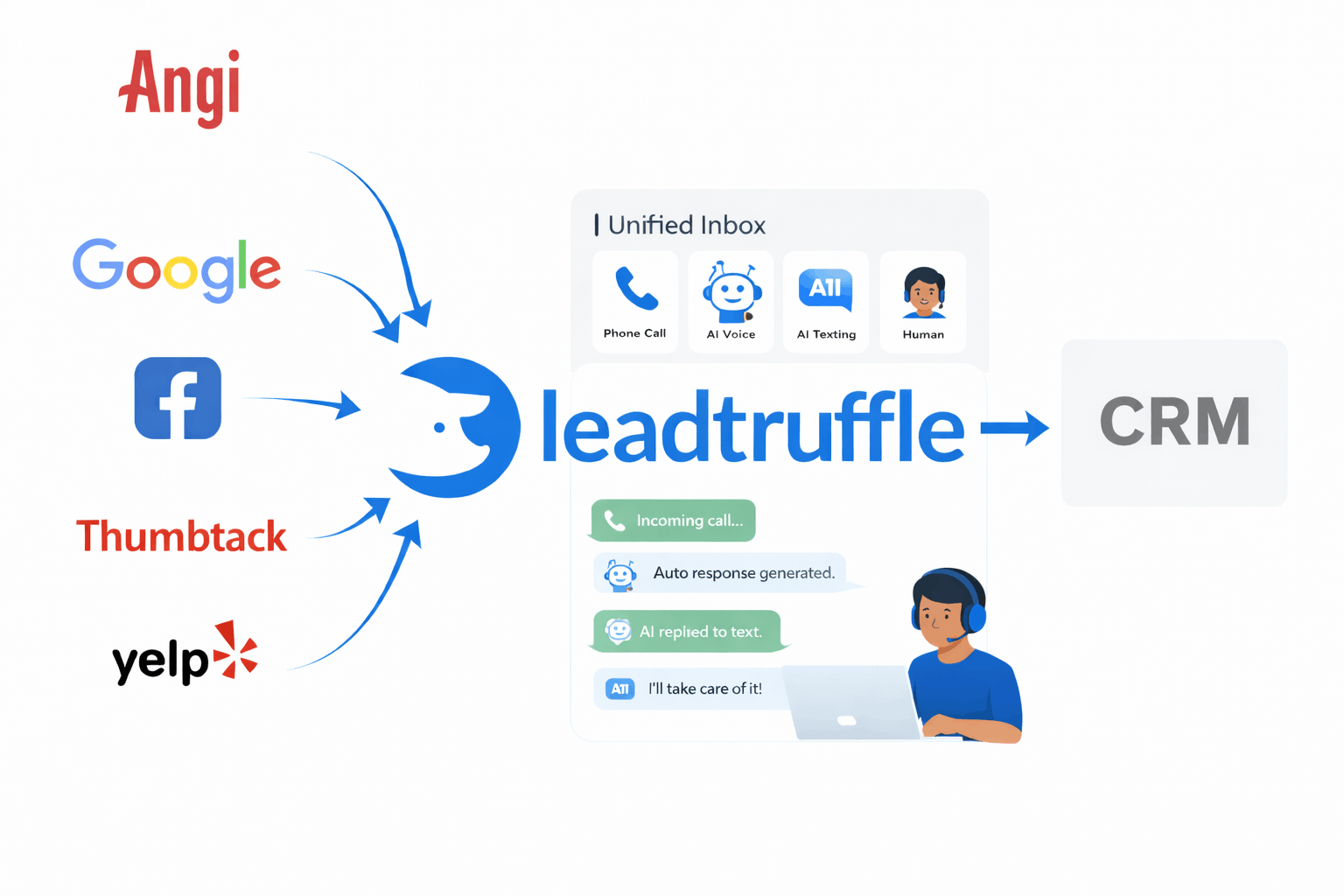
One unified inbox shows all your leads from every source - website, missed calls, Google, Facebook. No more checking five different places. No more leads slipping through.