Log In
LeadTruffle Insights
Appliance Repair Lead Generation: The Complete Guide for 2026
How to get more appliance repair leads in 2026. Covers Google Business Profile, LSA, reviews, after-hours response, pricing transparency, referral channels, and why trust and speed matter more than ad spend in appliance repair marketing.
Quick Answer
Appliance repair leads are won by the business that looks most trustworthy and reachable right when something breaks. This is not a brand-awareness game. It is a local search, reviews, and fast-response game. Consumer Reports found that 39% of people who had a large appliance break disposed of it because they could not find a repair company they were happy with. That is not a demand problem. It is a trust and visibility problem.
The playbook: get your Google Business Profile locked in, build a steady flow of recent reviews (47% of consumers will not use a business with fewer than 20), respond to leads within minutes (56% of homeowners want 24/7 scheduling or after-hours communication), and be transparent about your pricing. Google Local Services Ads are the highest-ROI paid channel for appliance repair because you pay per lead, not per click, and your reviews directly affect your ad ranking. After-hours lead capture matters more than most businesses realize - Housecall Pro data shows 41% of jobs booked online come in outside business hours.
Why Appliance Repair Lead Gen Is Different
Appliance repair is not like remodeling, landscaping, or HVAC installation. The buying behavior is fundamentally different:
- It is urgent. A broken fridge, a leaking dishwasher, or a dead washing machine with a full load inside is not something homeowners schedule for next month. They want someone today or tomorrow.
- It is local. Nobody is hiring an appliance tech from three towns over. Search behavior is intensely local - Google Maps, “near me” searches, and the Local Pack.
- It is trust-heavy. You are sending a stranger into someone’s home to work on something they do not understand. Reviews, photos, named technicians, and transparent pricing all reduce friction.
- The customer is often stressed or annoyed. The fridge died, the food is spoiling, or the washer flooded the laundry room. They are comparing options fast and picking whoever seems most reliable and available.
This means the traditional marketing funnel (awareness → consideration → decision) is compressed into minutes. A homeowner searches, scans the top results, checks reviews, and calls. If you do not show up in that initial search and look credible within seconds, you lose the lead. No amount of Facebook ads or brand-building compensates for being invisible at the moment of need.
The Market Is Real - But Homeowners Are Cost-Sensitive
Before diving into tactics, it helps to understand what is happening on the demand side.
Consumer Reports found that 60% of respondents had a large appliance stop working in the last five years. Among them, 58% replaced the product and 26% tried to repair it but could not. Here is the stat that matters most: 39% of people who had an appliance break disposed of it because they could not find someone they were happy with to fix it. That is not people choosing replacement over repair. That is people wanting repair and giving up.
That gap is your opportunity. Nearly 4 in 10 potential repair customers are falling through the cracks because the repair industry has a trust and accessibility problem.
On the cost side, Angi’s 2025 pulse survey of 1,000 homeowners found:
- 62% are more concerned about affording home maintenance than at the end of 2024
- 71% had postponed a planned home project
- 71% are focusing on preventative maintenance to avoid bigger costs
- Homeowners expect to stay in their current homes 5 years longer than originally planned
That cost sensitivity works in favor of repair businesses. People are staying put, stretching budgets, and choosing repair over replacement more often. The demand is there. The question is whether you are capturing it.
Google Business Profile: Your Most Important Free Asset
BrightLocal’s 2025 consumer search research found that 15% of consumers use Google Maps as their first stop for local search, 67% look at reviews after finding a local business, and 85% view contact information as an important factor.
For appliance repair, your Google Business Profile is often the first and only thing a potential customer sees before deciding to call. If it is incomplete, has stale reviews, or is missing basic information, you lose the lead before they even visit your website.
The Basics That Too Many Businesses Get Wrong
Based on industry data, here is what homeowners expect and what most service businesses fail to provide:
- Service areas clearly listed - 43% of home service businesses do not do this
- Business hours displayed - 65% do not show hours
- FAQ section - 74% are missing one entirely
These are free fixes. Before spending another dollar on ads, make sure your profile is not leaking leads through basic gaps.
Optimization Checklist
- Verify your business through Google’s screening process
- List every service separately - refrigerator repair, washer repair, dryer repair, dishwasher repair, oven repair, ice maker repair, garbage disposal, range hood repair
- Define service areas accurately by city or zip code
- Add high-quality photos - your van, your tools, completed repairs, your team in uniform
- Post business hours and update them for weekends, holidays, and emergency availability
- Enable messaging and booking - Google says these features can improve ad ranking
- Respond to every review - more on this below
- Use Google Posts - share seasonal tips like “5 signs your fridge compressor is failing” or “pre-summer AC and appliance check” offers
The AI Search Layer
BrightLocal also found that 40% of consumers actively use generative AI in search. Scorpion’s 2026 research puts it at 22% using AI tools like ChatGPT to research or find recommendations. Your Google Business Profile, reviews, and website content are not just being read by humans browsing search results. They are being consumed by AI systems that generate recommendations. Complete profiles with fresh, substantive reviews give these systems more signal to work with.
Reviews: Not Optional
Reviews in appliance repair are not a nice-to-have. They are functionally required.
BrightLocal’s 2026 Local Consumer Review Survey lays out the thresholds:
- 47% of consumers will not use a business with fewer than 20 reviews
- 74% only care about reviews from the last 3 months
- 31% will only use businesses with 4.5+ stars
- 37% factor in whether the owner responded to reviews
- 50% are put off by generic, templated review responses
That 74% recency stat is the one most appliance repair businesses miss. Having 80 reviews is great, but if your most recent one is from four months ago, it signals to customers that something changed. Fresh reviews are a continuous requirement, not a one-time achievement.
Building a Review System
The key word is “system.” Not “sometimes we ask.” A system.
- Ask after every completed job - the best moment is right after the appliance is working again and the customer is relieved
- Send a text with a direct Google review link - make it one tap, not a multi-step process
- Respond to every review within 24-48 hours - positive and negative, with specific responses, not templates
- Do not buy reviews or selectively solicit - the FTC’s Consumer Reviews and Testimonials Rule has been in effect since October 2024 and authorizes civil penalties for knowing violations. In December 2025, the FTC warned businesses that fake reviews and incentives tied specifically to 5-star reviews can trigger enforcement
BrightLocal found that 78% of consumers had been asked to write a review in the last 12 months, and 65% wrote one after being asked. Most customers will leave a review if you ask. Most businesses do not ask consistently.
“Your best business is word of mouth. Make sure to have a Facebook page and Google business where people can leave reviews.” - r/appliancerepair
Google Local Services Ads: The Best Paid Channel for Appliance Repair
Google lists appliance repair as an eligible category for Local Services Ads. For this trade specifically, LSA is the highest-ROI paid channel for several reasons:
Why LSA Works for Appliance Repair
- Pay per lead, not per click - you only pay when someone actually contacts you
- Google Guaranteed badge - instant trust signal for a category where trust is the primary buying factor
- Reviews directly affect LSA ranking - Google’s own documentation confirms that star ratings and review count affect your position
- You can dispute invalid leads for credit
- Lower CPL than search ads - typically $30-$70 vs $100+ for non-branded Google Ads
The Responsiveness Factor
Google’s documentation states that regularly failing to answer calls or respond to messages can affect your LSA ranking. This is a real problem for appliance repair techs who are mid-job, driving between service calls, or off the clock.
Setting up automated missed call text-back or an AI answering service keeps your LSA ranking healthy even when you are elbow-deep in a dishwasher repair.
LSA Caveats
LSA results can be inconsistent across markets. Some operators report strong lead flow, others spend their budget and get low-quality calls. Test it, measure your book rate (not just lead volume), and adjust. LSA works best as one piece of a multi-channel strategy, not your only source.
Google Search Ads (PPC)
Google search ads put you at the top of results for high-intent searches like “appliance repair near me” or “refrigerator repair [city].”
The Economics
“Appliance repair is not something I’d look for on Meta and I’m not going to remember a random ad I saw X days ago on there. Google Search would be where I’d be putting dollars since someone is going to need a repair, it’ll be ASAP and they’ll be looking for someone local and responsive.” - r/smallbusiness
That Reddit comment captures the economics precisely. Appliance repair is almost entirely reactive. Nobody browses Instagram thinking “I should get my dryer serviced.” They search Google when the dryer stops working. That makes Google the right channel for paid spend, not social media.
What Works
- Separate campaigns by appliance type - refrigerator repair, washer/dryer repair, dishwasher repair, and oven repair have different search volumes and competition levels
- Build dedicated landing pages for each appliance type - do not send fridge repair clicks to your homepage
- Use location targeting - only show ads in areas you actually serve
- Add call extensions - Invoca’s analysis of 60+ million home service calls found that 46% of phone leads convert on the call
- Negative keywords are critical - filter out “DIY,” “parts,” “how to,” “manual,” “jobs,” “salary,” and brand-specific searches for appliances you do not service
- Use call tracking - know which keywords produce paying customers, not just clicks
The Conversion Gap
Here is a stat that should change how you think about ad spend. Invoca’s 2025 home services benchmark report found that only 44% of businesses ask leads for a sale or booking on the call. More than half of phone leads hang up without anyone attempting to close them.
That means improving phone handling - asking for the appointment, offering same-day or next-day availability, quoting a clear diagnostic fee - can improve your conversion rate without increasing your ad spend by a dollar.
Your Website: The Trust Test
Housecall Pro’s research (1,040 U.S. homeowners) found that 96% expect a user-friendly professional website and 80% factor online booking into choosing a pro. Scorpion’s data adds that 74% research even personal referrals online before calling.
Your website is not a brochure. It is a trust test. Here is what appliance repair customers are checking:
Service Pages
Create individual pages for each appliance you service:
- Refrigerator and freezer repair
- Washer and dryer repair
- Dishwasher repair
- Oven, range, and cooktop repair
- Microwave repair
- Ice maker repair
- Garbage disposal repair
- Wine cooler and beverage center repair
- Commercial appliance repair (if applicable)
Each page should include the brands you service, common problems you fix, your service area, and a clear call to action.
Pricing Transparency
“I had a look at their site, I love how clear they are about their service/labour rates and why/how they bill things. Transparency is a very good sign for any business.” - Reddit
Appliance repair customers are skeptical about pricing. They have heard horror stories about $50 diagnostic fees that turn into $400 bills. Being upfront about your diagnostic fee, labor rates, and common repair costs builds trust before the phone rings.
You do not need to publish every price. But showing a diagnostic fee range, explaining how you bill, and listing common repair cost ranges (e.g., “Most refrigerator repairs: $150-$400, parts included”) removes a major objection.
Conversion Essentials
- Phone number prominent on every page (click-to-call on mobile)
- Online booking or scheduling option
- Contact form on every service page
- Clear service areas listed
- Business hours displayed, including emergency or after-hours availability
- Real photos of your team and work, not stock images
- FAQ section answering common questions
Scorpion’s research found 59% of homeowners want multiple ways to contact a business. Phone, text, online form, and online booking should all be available.
After-Hours Lead Capture: The Biggest Missed Opportunity
This is where most appliance repair businesses leave the most money on the table.
Housecall Pro’s data shows 41% of jobs booked online come in after hours. Scorpion found 56% of homeowners want 24/7 scheduling or after-hours communication. Appliance emergencies - a leaking dishwasher, a fridge that stopped cooling with a full load of groceries - often happen in the evening or on weekends. If your phone goes to voicemail at 5 PM, you are missing a huge share of your most urgent, highest-intent leads.
Options for After-Hours Coverage
- AI answering service - an AI voice agent picks up when you can’t, qualifies the caller, and sends you the details
- Automated text-back - when a call goes unanswered, immediately text the caller to acknowledge the missed call and start qualification
- Online booking - let customers self-schedule from your website without needing a phone call
- Live answering service - human operators, typically $1-$3 per call, but quality varies and they cannot answer technical questions
Housecall Pro also found that 53% of homeowners are comfortable with AI handling initial inquiries. The bar for after-hours coverage is lower than many business owners assume. Customers do not need a master technician answering the phone at 10 PM. They need to know someone received their message and will follow up.
Scorpion’s data drives this home: 88% of homeowners expect a response within 24 hours. If your first response to a Saturday evening call comes Monday morning, you have already lost to the competitor who texted back in 30 seconds.
Speed to Lead: The Appliance Repair Advantage
Response speed matters in every home service trade, but in appliance repair the window is especially tight. When a fridge dies, the homeowner is not running a methodical two-week evaluation process. They are calling the first three businesses that show up, and going with whoever answers or responds first.
Jobber’s 2026 data shows 60% of home service pros respond to leads the same day and 20% within the hour. That means 40% take longer than a day. In appliance repair, where the need is immediate, same-day response is the minimum - and within-the-hour response is what separates the businesses that win from the ones that chase.
How to Fix Your Response Time
- Automated text-back for missed calls - the caller gets an instant text acknowledging their call and asking about their issue
- AI qualification over text - collects appliance type, brand, problem description, address, and preferred timing while you are on another job
- AI phone answering - an AI voice agent picks up when you cannot, qualifies the caller, and sends you the details
- Instant notifications - every lead triggers a push notification so you can call back during your next break
- Online booking - let customers self-schedule without needing a phone conversation
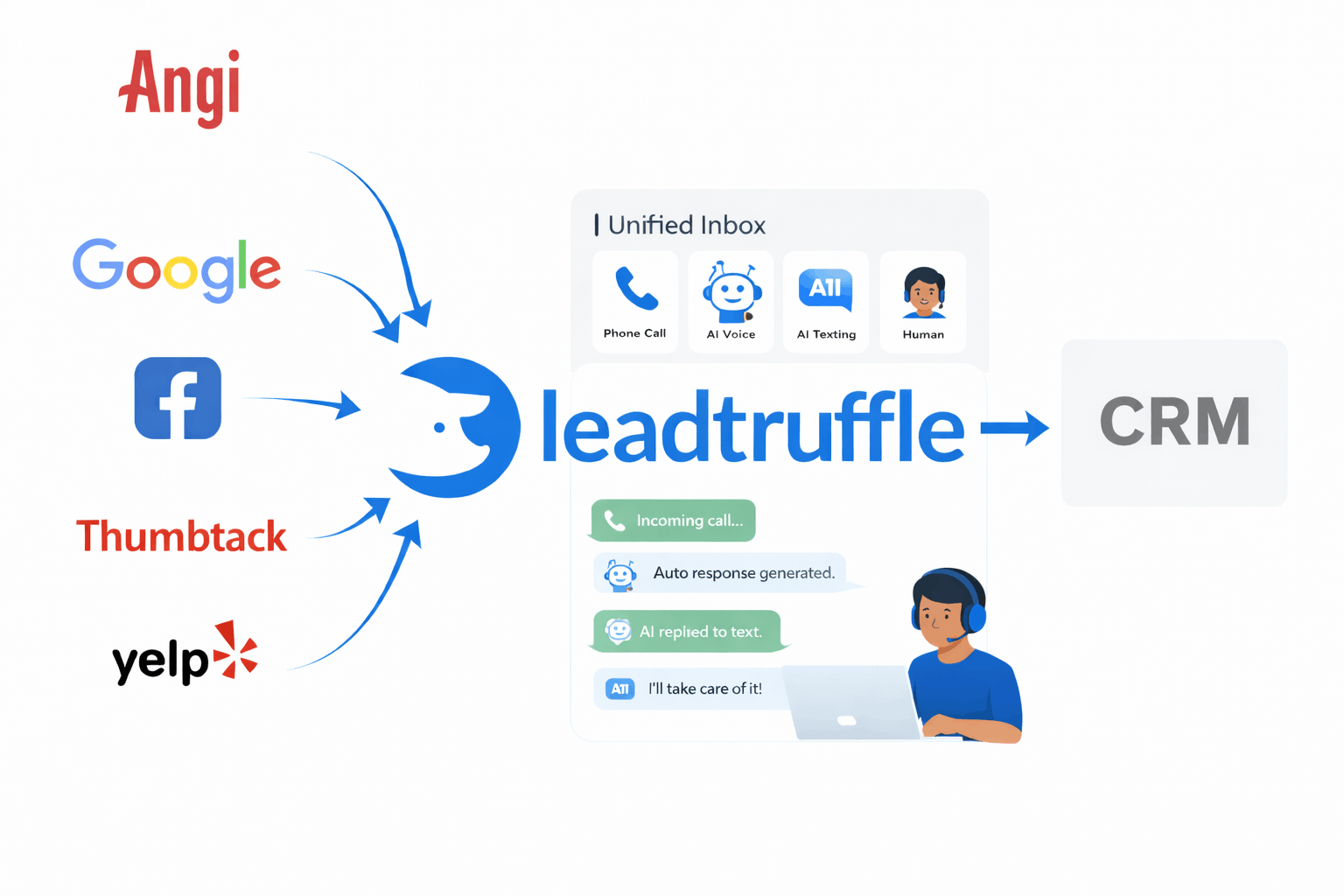
If you use lead aggregator platforms like Angi, Yelp, or Thumbtack, having those leads flow into a unified inbox with immediate AI response dramatically improves your odds of being first to connect.
Phone Handling: The Forgotten Conversion Lever
Invoca’s analysis of more than 60 million home service phone calls reveals how much revenue is lost on the phone, not in marketing:
- 55% of callers speak with a person
- 37% of calls from digital marketing are leads
- 46% of those leads convert on the call
- Only 44% of businesses ask leads for a sale or booking
That last number is the most important. More than half of home service businesses are answering the phone, talking to qualified leads, and hanging up without asking for the appointment. In appliance repair, where the customer already wants the repair and just needs to be told “yes, we can come tomorrow,” the fix is straightforward:
- Answer with availability - “We can get someone out tomorrow morning” closes more calls than “let me check the schedule and call you back”
- State your diagnostic fee clearly - uncertainty about cost is the #1 reason callers hesitate
- Ask for the booking - “Want me to put you down for tomorrow between 8 and 10?” is not pushy. It is helpful.
- If you cannot answer, respond within minutes - automated text-back fills this gap
Lead Aggregators: Worth It or Not?
Platforms like Angi, Thumbtack, and Yelp sell appliance repair leads. The question every business owner asks: are they worth the cost?
The Case Against (Usually)
The structural problem with most lead aggregators is that leads are shared with multiple businesses. When three repair companies call the same homeowner within five minutes, it turns into a price race. That drives down margins and builds zero brand equity.
Common complaints from operators:
- Leads shared with 3-5 competitors
- Leads outside your service area
- Quality is inconsistent
- Difficult to get credits for bad leads
When They Might Make Sense
- You are new and need any jobs to build reviews
- You have technician capacity sitting idle
- You are testing a new market or expanding your service area
- You treat them as a minor supplement (under 20% of leads), not your strategy
Make Aggregator Leads Work Harder
If you do use aggregators, the key is speed. The first business to respond wins the shared lead far more often than the cheapest. Having aggregator leads from Yelp, Thumbtack, and Angi automatically trigger an AI response means you are connecting with the lead in seconds, not hours. That single advantage can make aggregator leads profitable when they otherwise would not be.
Referrals and Local Partnerships
Jobber’s 2026 data confirms that referrals and repeat customers are the top lead sources at 59% each across home services. Appliance repair is no different.
Customer Referrals
- Ask after every completed job - right after the appliance is working again
- Make it easy - a text with your Google review link doubles as a referral prompt
- Offer a meaningful incentive - $25 off their next repair, a free diagnostic, or a maintenance check
- Follow up at 30 and 90 days - referral opportunities often arise weeks after service
Property Managers and Landlords
This is the most overlooked channel for appliance repair businesses. Property managers deal with appliance issues constantly. A broken fridge in a rental unit needs to be fixed fast and on budget. If you can offer reliable turnaround and clear invoicing, property managers will send you recurring volume.
“The other thing you can try and do is get your door in with property rental companies. We work with a few different property management companies out here…” - r/appliancerepair
Other Local Partnerships
- Appliance retailers - some retailers offer repair referrals for out-of-warranty units
- Real estate agents - pre-sale home inspections flag appliance issues
- Home warranty companies - high volume but lower margins, can fill gaps in your schedule
- General contractors - renovation projects often include appliance installations
- Other trades - plumbers, electricians, and HVAC techs encounter appliance issues on their jobs
Diversify Your Sources
Jobber’s data shows top-performing home service businesses use 3 to 5 lead sources. After referrals and repeat customers, the next most common channels are Facebook (32%), local networking and partnerships (25%), Google Search (20%), and LSAs (19%).
Do not rely on one channel. A balanced mix of referrals, organic search, LSA, and one paid channel gives you stability when any single source fluctuates.
The “Don’t Be Shady” Advantage
Appliance repair has a trust problem. Homeowners have heard stories about inflated repair quotes designed to push them toward buying a new appliance, hidden diagnostic fees, and phantom parts charges. Whether these stories are representative or not, they are what your potential customer is thinking when they call.
Being genuinely transparent is a competitive advantage:
Pricing
- Publish your diagnostic fee on your website and in your Google Business Profile
- Explain how you bill - flat rate vs hourly, whether the diagnostic fee applies to the repair
- List common repair cost ranges - you do not need exact prices, but “Most dishwasher repairs: $100-$300” removes uncertainty
- Be honest about the repair vs replace decision - if a repair costs more than 50% of a new appliance, say so. Customers respect honesty and will call you next time.
Presentation
Scorpion’s research found that nearly 60% of homeowners appreciate seeing a technician’s name and photo before the visit, and over 70% would pay more for a pro with a better service reputation. Small touches matter:
- Technician name and photo sent before the appointment
- Branded uniform and vehicle
- Shoe covers and cleanup after the job
- Written summary of what was done and what to watch for
Photos
Google’s guidelines say Business Profile photos should represent reality. Use real photos of your team, your van, and completed work. Stock photos of smiling models in pristine kitchens actively hurt credibility. Homeowners can tell.
“People like established. They like familiar.” - r/appliancerepair
The Labor Supply Context
BLS reported 31,940 home appliance repairers nationally in May 2024, with a mean annual wage of $53,580. The highest employment concentrations are in Florida, California, and Texas.
Those are not large numbers. Appliance repair is not a trade with an oversupply of technicians. That helps explain why availability, service area design, and fast scheduling matter so much. Customers are often shopping in a market that does not have a lot of extra capacity. If you can offer same-day or next-day service when your competitors are quoting 3-5 day waits, that availability alone wins the job.
Putting It All Together: The Appliance Repair Lead Gen Stack
The businesses winning in appliance repair in 2026 are not doing one thing well. They are stacking several advantages:
- Google Business Profile is complete, optimized, and actively maintained - service listings, photos, hours, service areas, posts
- Reviews are fresh and plentiful - a system that generates 4-8 new reviews per month, every month
- Google LSA is running - pay-per-lead with the Google Guaranteed badge
- Website is fast, mobile-friendly, and transparent - individual service pages, clear pricing, online booking
- After-hours leads are captured - AI answering, missed call text-back, and online scheduling ensure no lead falls through after 5 PM
- Response time is measured in seconds, not hours - AI lead qualification handles the first touch while you are on a job
- Phone calls are handled as sales conversations - availability stated, diagnostic fee quoted, appointment offered
- Aggregator leads get instant responses - Yelp, Thumbtack, and Angi leads trigger immediate AI follow-up
- Referrals are actively cultivated - asks after every job, property manager relationships, local partnerships
- Pricing and presentation build trust - transparency, real photos, technician intros, clean worksites
None of these individually are revolutionary. But most appliance repair businesses are missing three or four of them. Fix the gaps, and you are ahead of the large majority of your competitors - not because you outspent them, but because you out-trusted and out-responded them.
Data sources: Consumer Reports (appliance repair consumer research), BrightLocal (2025 consumer search, 2026 review survey), Angi (2025 State of Home Spending Pulse Report, 1,000 homeowners), Housecall Pro (2025 homeowner survey, 1,040 respondents), Scorpion (2026 Home Services Report, 2,000 homeowners + 1,000 business leaders), Invoca (2025 Call Conversion Benchmarks, 60M+ calls), BLS (occupational employment data, May 2024), Google (Local Services Ads documentation), FTC (Consumer Reviews Rule). Reddit comments are used for operator perspective, not as statistical evidence.