Log In
LeadTruffle Insights
What Is a Lead Aggregator? (And Why Home Service Businesses Should Care)
Lead aggregators sell shared leads to multiple contractors at once. Learn how they work, what they cost, and why many home service businesses are moving away from them.
Short Answer
tl;dr: Lead aggregators collect homeowner requests and sell the same lead to multiple contractors. They usually charge per lead (sometimes with monthly or annual fees), so you pay even if you do not win the job. The model can fill your pipeline fast, but it drives price competition and makes response time critical.
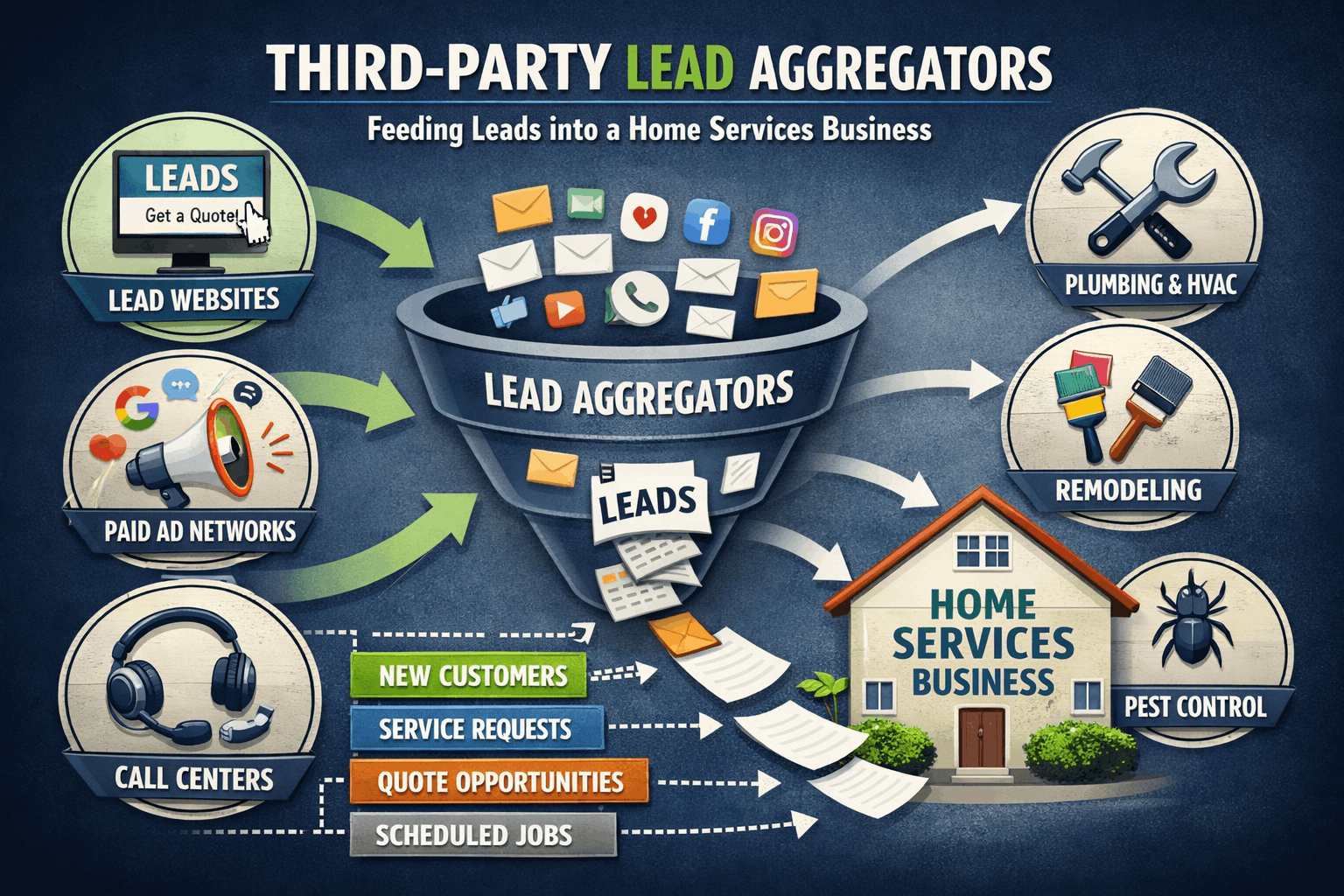
A lead aggregator is a company that collects customer inquiries and sells them to multiple businesses at once. In home services, this means a homeowner fills out one form asking for a plumber, and that same lead gets sold to four, five, or even six plumbing companies simultaneously.
You’ve probably heard of the big ones: Angi (formerly HomeAdvisor), Thumbtack, Porch, Bark, and Networx. These platforms spend millions on advertising to attract homeowners, then charge contractors for access to those leads.
The model sounds efficient in theory. Homeowners get multiple quotes quickly. Contractors get leads without running their own marketing. But the reality is more complicated - and often expensive - for the contractors paying the bills.
How Lead Aggregators Work
The basic model is simple:
- A homeowner searches Google for “plumber near me” or “roof repair”
- They click on an aggregator’s ad or website
- They fill out a form describing what they need
- The aggregator sells that lead to multiple contractors in the area
- Those contractors all call at once, competing for the same job
Most aggregators charge per lead, regardless of whether you win the job. Some also charge monthly membership fees. A few offer “exclusive” leads at higher prices, but the default model is shared leads.
When a lead arrives, you’re racing against other contractors who received the same information at the same moment. The homeowner’s phone starts ringing from multiple companies. Whoever calls first, answers questions best, and offers a competitive price usually wins.
Industry data shows 35-50% of jobs go to the contractor who responds first. If you’re slow, you paid for a lead you had almost no chance of closing.
The Major Lead Aggregator Platforms
Here’s how the biggest platforms compare:
Angi Leads (HomeAdvisor)
Angi Leads is one of the largest home service lead providers. They charge roughly $15-$85 per lead depending on the job type, plus an annual membership fee around $350.
Leads typically go to 4+ contractors at once. Angi does offer “exclusive” leads at higher prices, but most leads are shared. The platform requires background checks and license verification, which gives homeowners some trust signal.
Contractors report mixed results. Some grow their business on Angi. Others spend heavily with little return, citing unqualified leads or customers who are just price-shopping. One analysis found contractors might spend over $1,400 in total fees per customer acquired through the platform.
Thumbtack
Thumbtack charges per lead with no monthly fee. Typical costs run $10-$50 per lead depending on job type and location.
You only pay when a customer contacts you or when you respond to their request. Leads are shared - a customer might reach out to 1-5 contractors at once. Thumbtack shows you how many other pros received each lead.
The platform works on a pure marketplace model. No upfront commitment makes it lower-risk to try, but you still compete on speed and price for every lead.
Porch
Porch partners with retailers like Lowe’s to generate leads. They offer two payment models: pay-as-you-go ($5-$65 per lead depending on job size) or a monthly subscription with discounted rates.
Porch limits each project to four contractors maximum - slightly less competition than some platforms. Subscribers get first access to new leads.
Bark
Bark uses a credit system. You buy credits in advance, then spend them to unlock lead contact information. A lead might cost 3-20 credits ($5-$36 in real money) depending on job value.
The catch: Bark doesn’t limit how many contractors can buy the same lead. If 10 contractors all pay for a popular lead, that homeowner gets 10 calls. Many contractors report quality issues - leads that are old, unresponsive, or already hired someone else.
Networx
Networx offers both subscription and pay-per-lead options. Standard leads cost $10-$100 each and go to up to 4 contractors. They also offer exclusive leads at $15-$120+ where you’re the only contractor who receives it.
The exclusive option is worth considering if available in your area and trade - you’re not competing in real-time with other contractors.
What Lead Aggregators Actually Cost
The sticker price per lead doesn’t tell the full story. You need to calculate your actual cost per customer.
The Math Problem
Say you pay $75 per lead on average. If you close 1 in 8 leads (12.5% close rate - common for shared leads), your effective cost per customer is $600.
On a $10,000 roofing job with 40% gross margin, you’re spending 15% of your gross profit just on lead acquisition. And you built zero brand equity in the process.
Compare that to a referral lead that costs nearly nothing and closes at 50%+.
Typical Costs by Platform
| Platform | Cost Per Lead | Leads Shared With | Close Rate (Typical) |
|---|---|---|---|
| Angi/HomeAdvisor | $15-$85 + $350/yr membership | 4-6 contractors | 10-20% |
| Thumbtack | $10-$50 | 1-5 contractors | 15-25% |
| Porch | $5-$65 | Up to 4 contractors | 15-25% |
| Bark | $5-$36 (credits) | Unlimited | 10-15% |
| Networx | $10-$100 (shared) or $15-$120 (exclusive) | 4 or exclusive | 15-25% (shared), 30%+ (exclusive) |
These numbers vary by trade, location, and how quickly you respond. But the pattern holds: shared leads close at much lower rates than exclusive leads or referrals.
Why Contractors Use Lead Aggregators
Despite the drawbacks, aggregators serve real purposes:
Getting started: New contractors with no reputation can get in front of customers immediately. A few closed jobs build your review profile and portfolio.
Filling gaps: When your schedule has holes, buying a few leads can drum up quick work. Better than a crew sitting idle.
Testing new markets: Expanding to a new service area? Aggregator leads can test demand without heavy marketing investment.
Volume at scale: Some larger contractors run aggressive sales operations optimized for shared lead competition. They accept lower margins in exchange for predictable volume.
The problem is when aggregators become your primary lead source. You’re paying recurring fees for one-time opportunities. Nothing compounds. You’re back to zero next month.
The Problems with the Aggregator Model
Shared Leads Create Race-to-the-Bottom Competition
When four contractors call the same homeowner within minutes, price often becomes the deciding factor. The homeowner gets overwhelmed with options and picks whoever seems cheapest or fastest.
This commoditizes your service. Your 20 years of experience, your certifications, your warranty - none of that matters when you’re competing against three other phone numbers the customer received at the same time.
You’re Paying for Leads That Won’t Convert
Not every lead is ready to buy. Some are price-shopping. Some filled out a form by accident. Some already hired someone.
With aggregators, you pay for the lead regardless. If you spend $50 and the customer never answers the phone, that’s $50 gone. If they say “I already found someone,” that’s $50 gone. If they’re just getting prices for a project they might do next year, that’s $50 gone.
The platforms do offer refunds for clearly invalid leads (wrong phone numbers, out of area), but you have to proactively request them. Marginal leads - real people who just aren’t ready - don’t qualify.
You Own Nothing
Every dollar you spend on aggregators is gone the moment you spend it. You’re not building SEO. You’re not building a review profile you control. You’re not building an email list. You’re not building brand recognition.
If you stop paying, the leads stop. If the platform raises prices, you pay more or get fewer leads. If they change their algorithm, your lead flow changes without your input.
Compare this to investing in your own website, Google Business Profile, or referral program. Those assets keep generating leads over time. They compound.
Quality Varies Widely
Aggregators attract every type of homeowner - including those who fill out forms on multiple platforms simultaneously, those looking for the absolute lowest price, and those who aren’t serious buyers.
Some contractors report great results. Others report spending thousands on leads that never convert. The difference often comes down to trade, location, and whether your local market has serious competition on the platform.
Lead Aggregators vs Other Lead Sources
Here’s how aggregator leads compare to other channels:
| Lead Source | Cost Per Lead | Close Rate | You Own the Asset? |
|---|---|---|---|
| Referrals | ~$0 | 50%+ | Yes (relationships) |
| SEO/Organic | <$50 (amortized) | 30-50% | Yes (website/content) |
| Google LSA | $20-$100 | 25-40% | Partially (reviews count) |
| Google PPC | $50-$200 | 20-35% | Yes (ad account data) |
| Facebook Ads | $20-$80 | 15-25% | Yes (pixel data, audiences) |
| Lead Aggregators | $15-$100 | 10-25% | No |
The pattern: channels where you control the asset or where the customer chose you specifically convert at higher rates than shared leads where you’re one of several options.
Google Local Services Ads: A Different Model
Google LSA deserves special mention because it’s often compared to lead aggregators but works differently.
With LSA, you pay per lead (phone call or message). But the customer chooses you from the results - they see your rating, your Google Guaranteed badge, and they pick your listing. That lead goes to you, not to four competitors simultaneously.
Typical LSA costs run $20-$100 per lead depending on trade and location. Many contractors report LSA delivers better ROI than traditional aggregators because:
- Leads are essentially exclusive (customer picked you)
- The Google Guaranteed badge builds trust
- Your Google reviews directly influence your ranking
- You can dispute invalid leads for refunds
The screening process requires background checks and license verification. But once approved, LSA often becomes a primary lead source for contractors who qualify.
When to Use Lead Aggregators
Aggregators make sense in specific situations:
You’re brand new and need any jobs to build reviews and portfolio. Paying for leads beats waiting months for organic marketing to work.
You have immediate capacity and would rather pay for a lead than have workers sitting idle. Short-term cash flow beats long-term efficiency.
You’re testing a new service or market before investing in dedicated marketing.
You’ve optimized your sales process for shared lead competition - fast response, competitive pricing, high close rates.
When to Avoid Lead Aggregators
Avoid making aggregators your primary strategy if:
You can’t respond within minutes. Shared leads require immediate response. If your phone goes to voicemail during work hours, you’re wasting money.
Your margins are tight. If you need every job to be profitable, paying $75 for leads that close at 15% probably doesn’t work mathematically.
You’re building for the long term. Every dollar spent on aggregators is a dollar not spent on assets you own - SEO, content, direct advertising, referral programs.
You’re in a saturated market. If 10 contractors are competing for every lead in your area, close rates drop and you’re mainly competing on price.
The Shift Toward Owned Lead Generation
More contractors are moving away from aggregator dependence toward “owned” lead channels:
Your website + SEO: Invest in ranking for local searches. When someone finds you on Google and calls directly, that’s an exclusive lead at no marginal cost.
Google Business Profile: Optimize your listing, collect reviews, post updates. Free leads come from people who specifically chose your business.
Google LSA: Yes, you pay per lead, but you keep your Google reviews and the customer picked you specifically.
Referral programs: Formalize asking for referrals. Offer incentives. Past customers send warm leads that close at 50%+.
Email/SMS marketing: Stay in touch with past customers. When they need service again or know someone who does, you’re top of mind.
Social media and community: Nextdoor recommendations, Facebook group mentions, local community presence. All free, all build over time.
The common thread: these channels build assets. Your website ranks higher each year. Your review count grows. Your referral network expands. The leads get cheaper and better over time.
With aggregators, year five costs the same as year one. Nothing improved.
How to Calculate If Aggregators Work for You
Before committing to any platform, run the numbers:
Step 1: Track your current close rate on aggregator leads. If you don’t know this, you can’t evaluate ROI. Track every lead source and outcome for at least a month.
Step 2: Calculate your actual cost per customer. (Total spent on platform) ÷ (Customers acquired) = Cost per customer
Step 3: Compare to your job margin. If you net $2,500 on an average job and aggregators cost you $600 per customer, that’s 24% of your profit going to lead acquisition. Is that sustainable?
Step 4: Compare to other channels. What does a referral cost you? An SEO-generated lead? A Google LSA call? Allocate budget to whatever delivers the best ROI.
Step 5: Factor in lifetime value. A customer acquired through any channel might refer others, leave reviews, or hire you again. An aggregator customer is the same as any other once acquired - but you paid more to get them.
The Bottom Line
Lead aggregators are tools, not strategies. They can fill gaps, help new businesses get started, or provide volume when you need it. But they’re expensive, competitive, and build nothing for your future.
The contractors who thrive long-term invest in channels they own: their website, their reputation, their referral network, their direct advertising. These assets compound. The leads get better and cheaper over time.
If you’re currently dependent on aggregators, that’s okay - many contractors start there. But have a plan to build owned channels in parallel. Every review you collect, every referral you earn, every website visitor who finds you on Google is a step toward sustainable lead generation that doesn’t reset to zero each month.
Stop Renting Leads. Start Owning Them.
LeadTruffle helps home service businesses capture and qualify leads from their own website, missed calls, and direct marketing - not shared leads from aggregators.
When a potential customer visits your site or calls your number, our AI engages them instantly via text, qualifies them with your specific questions, and delivers ready-to-book customers to your inbox. You’re not competing with four other contractors. You’re talking to someone who already chose you.