Log In
LeadTruffle Insights
The Complete Guide to Google Local Services Ads for Home Service Contractors in 2026
Everything contractors need to know about Google LSA in 2026: setup requirements, costs by trade, the new Google Verified badge, lead dispute process, and optimization strategies that actually work.
Short Answer
tl;dr: Google Local Services Ads are still one of the best ROI channels for contractors, but the platform changed in late 2025 with a new unified badge and automated lead credits. If you want LSA to work in 2026, you need clean verification, fast response times, and a system for disputing bad leads. This guide covers setup, costs, and optimization.
Google Local Services Ads remain one of the highest-ROI lead generation channels for home service contractors in 2026. But significant platform changes—including a new unified badge system and automated lead credits—have reshaped how contractors should approach the platform.
This comprehensive guide covers everything from setup requirements to real contractor experiences, with specific cost data and optimization strategies for maximizing your return.
What Changed in Late 2025 and Why It Matters
Google fundamentally restructured its LSA trust system in October 2025, replacing the familiar Google Guaranteed, Google Screened, and License Verified badges with a single “Google Verified” badge. More significantly, the consumer money-back guarantee that defined the Google Guaranteed program for years was discontinued on November 7, 2025.
Several other major changes affect contractors entering 2026:
- Mandatory GBP linking (November 2024): Your Google Business Profile and LSA profiles must match exactly
- LSA app retired (January 2025): Management moved to the Google Ads platform
- AI-automated credits (July 2024): Manual lead disputes replaced with automated system—generating significant contractor frustration
Despite these changes, LSA remains compelling. The platform captures 13.8% of all SERP clicks when LSAs appear, and 29% of searchers prefer clicking LSA results compared to just 11% for traditional Google Ads. The pay-per-lead model means you only pay when customers actually contact you.
Setup Requirements and the Verification Process
Creating Your LSA Account Step by Step
The setup process begins at ads.google.com/local-services-ads, where you’ll enter your postal code and select your service category. Google currently supports over 70 service categories including HVAC, plumbing, electrical, roofing, landscaping, pest control, garage door repair, locksmith services, and house cleaning.
After confirming eligibility, you’ll need to:
- Create or link a verified Google Business Profile with matching business name, address, and phone number
- Fill out business details including owner’s name, founding year, and business hours
- Define service areas by state, city, county, neighborhood, or zip code (up to 20 areas)
- Select specific job types from Google’s predefined checklist for your trade
- Complete all verification requirements through the Business Verification tab
- Set your weekly budget based on desired lead volume
The typical timeline from application to going live is 2-6 weeks, depending primarily on documentation completeness and how many employees require background checks.
Background Check Requirements
Every business owner and field worker who enters customer homes must pass background checks conducted by Pinkerton Consulting and Investigations or Evident. The checks are free and include:
- Social Security validation
- Criminal history review
- Cross-checks against national sex offender and terrorist registries
- Company-level civil litigation history review
Critical warning: One failed background check disqualifies the entire business. If denied, you must wait 30 days before reapplying; a second denial triggers a 180-day waiting period.
Background checks are re-run annually, and you must notify Google immediately when hiring new field workers.
License and Insurance Documentation
License requirements vary by state and trade. Google verifies state-level licenses against official databases. High-risk categories—including locksmiths, garage door services, plumbers, and electricians—face additional scrutiny through Advanced Verification screening, which may include video interviews.
Insurance requirements typically include general liability coverage of at least $1 million. Your Certificate of Insurance must show:
- Valid signature and policy number
- Coverage active for at least 14 days after submission
- Business name matching your advertised name exactly
- Coverage amount meeting or exceeding the required minimum
- Business address covering your service area
The New Google Verified Badge System
As of October 20, 2025, all previously verified businesses transitioned to the unified Google Verified badge. This blue checkmark displays dynamically alongside details of which verification checks you’ve passed.
The previous Google Guaranteed badge included a money-back guarantee of up to $2,000 for dissatisfied customers. This consumer protection ended November 7, 2025.
Common Rejection Reasons
Documentation mismatches cause the most rejections. Your business name, address, and phone number must match exactly across:
- LSA profile
- Google Business Profile
- License documents
- Insurance certificates
Even minor discrepancies—like “Street” versus “St.”—can trigger rejection.
Using the Platform Effectively
Dashboard Navigation and Lead Management
The LSA dashboard organizes around four key sections:
- Leads: View and manage incoming inquiries
- Profile & Budget: Edit business information and spending
- Reports: Performance analytics
- Settings: Business hours and job type configuration
Leads arrive in three forms: phone calls (90% of leads), messages, and bookings. Enable all lead types to maximize volume.
Service Areas and Job Types
You can target up to 20 service areas per account. For multi-location businesses, create separate LSA accounts for each major market for more precise budget control.
Job type selection directly controls which searches trigger your ads. If you don’t enable a particular job type, you’re invisible for those searches. However, listing services you won’t deliver backfires—declined leads train Google’s algorithm to show your ad less frequently.
Budget Strategy That Maintains Visibility
Google recommends budgeting for approximately 10 leads per week for optimal algorithm performance. Starting budgets of $500-$2,000 monthly allow meaningful testing.
A common mistake is setting weekly budgets too low. If leads cost $40 each, a $150 weekly budget means you get 3-4 leads then go dark Thursday through Sunday while competitors keep showing.
Three bidding strategies are available:
- Maximize Leads (automated): Google’s recommended default
- Target Cost Per Lead: Automated bidding with a specified average CPL target
- Max Per Lead (manual): You set maximum bid amounts
Start with Maximize Leads and only switch to manual bidding if results disappoint.
Response Time is a Critical Ranking Factor
Google explicitly states that failing to answer calls or respond to messages affects your ad ranking. Industry data reveals the severity: 74.1% of contractor calls go completely unanswered.
Best practices:
- Answer calls within 30 seconds
- Respond to messages within 4 hours
- Set up dedicated staff for LSA lead handling
- Configure real-time mobile notifications
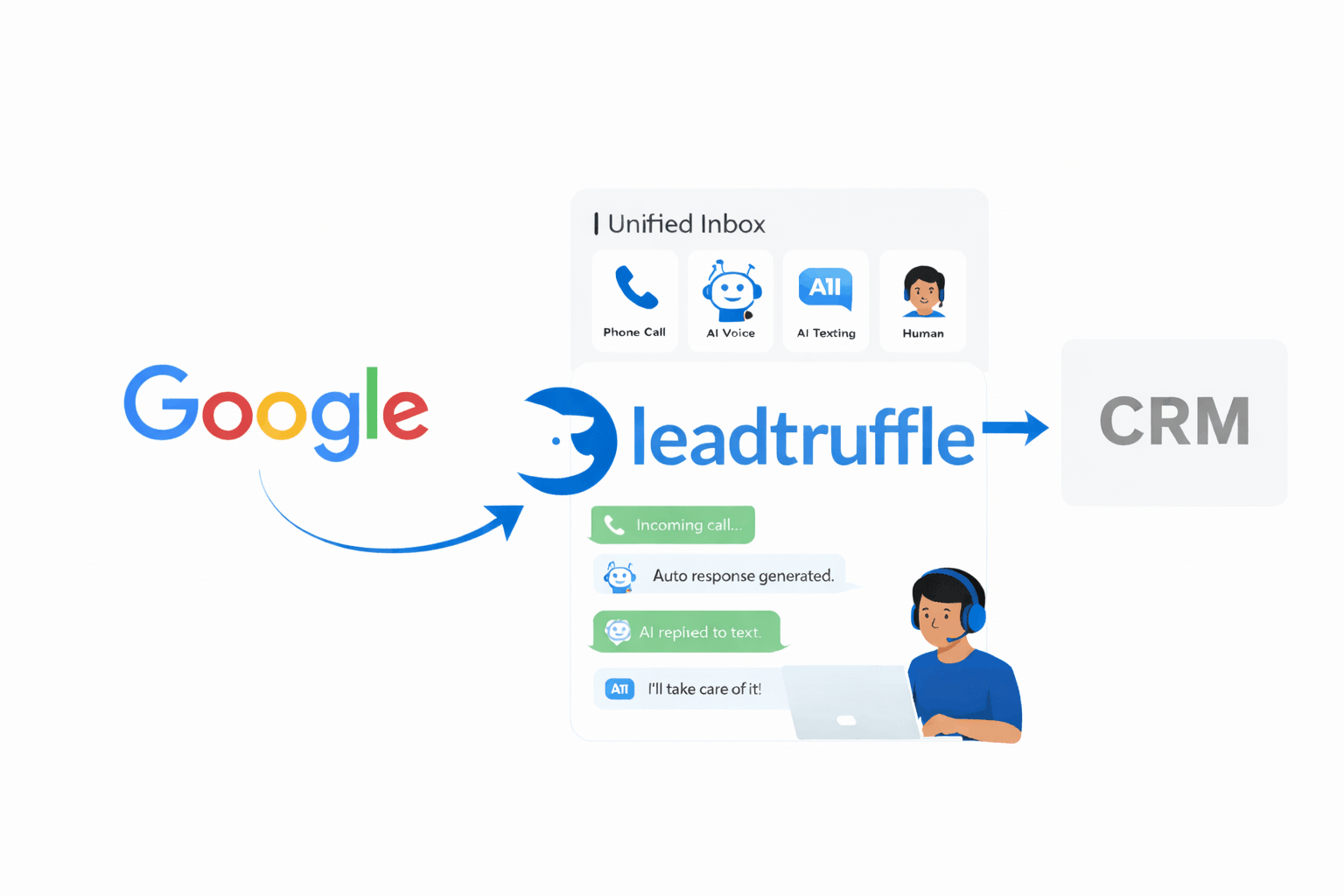
This is where AI lead qualification and missed call text-back become critical—ensuring you never miss a lead even when you can’t answer the phone.
How Lead Generation and Ranking Actually Work
The LSA Algorithm’s Ranking Factors
Tier 1 factors with highest impact:
- Review score (4.8+ stars to compete seriously)
- Review quantity (150 reviews at 4.8 beats 30 reviews at 5.0)
- Responsiveness to calls and messages
- Proximity to the searcher’s location
Tier 2 factors with significant influence:
- Business hours alignment with search timing
- Review recency (steady flow outperforms stale reviews)
- Google Verified badge status
- Profile completeness including photos
Tier 3 contributing factors:
- Budget and bid amounts
- Lead feedback (marking leads as booked signals success)
- Accurate service selection
Lead Exclusivity: LSA’s Major Advantage
Lead exclusivity is a major LSA advantage over platforms like HomeAdvisor or Thumbtack. When a customer selects your profile and contacts you, that lead is yours exclusively—not simultaneously sent to multiple competitors.
However, Google began testing a “Message Multiple Businesses” feature in late 2025 that allows customers to request quotes from up to four businesses simultaneously. If fully implemented, this would reduce the exclusivity advantage for message leads.
Strategies That Increase Lead Flow
Contractors who generate the most leads consistently focus on:
- Maintaining 50+ reviews with 4.7+ star average
- Responding to every lead within minutes
- Enabling all lead types (phone, message, booking)
- Setting 24/7 availability for emergency services
- Requesting reviews within 24 hours of job completion
- Uploading 15-20 high-quality photos
One marketing manager reported receiving 80-100 leads per day when their business maintained a 4.8-star rating with strong review volume.
Cost Analysis by Trade and Market
Average Cost Per Lead Across Home Services
Based on aggregated 2024-2025 data from marketing agencies managing hundreds of LSA accounts:
| Trade | Average CPL Range | Typical Average |
|---|---|---|
| HVAC | $45-$85 | $80 |
| Plumbing | $40-$75 | $69 |
| Electrical | $35-$70 | $50 |
| Roofing | $50-$162 | $95 |
| Landscaping | $30-$50 | $39 |
| Pest Control | $25-$50 | $35 |
| Garage Door | $40-$80 | $60 |
| Locksmith | $30-$40 | $34 |
| House Cleaning | $28-$47 | $35 |
| Carpet Cleaning | $25-$45 | $35 |
| Water Damage | $50-$100+ | $75 |
| Appliance Repair | $25-$50 | $40 |
Geographic Variation
Urban markets command significantly higher lead costs. New York, Los Angeles, and Chicago see lead costs 20-50% above national averages, with some trades reaching $100+ per lead.
Budget Recommendations by Business Size
- New or small businesses: $500-$1,000 monthly (10-20 leads)
- Established SMBs: $1,500-$3,000 monthly (30-50 leads)
- Larger operations: $3,000-$10,000+ monthly
How LSA Compares to Other Lead Sources
LSA vs. Thumbtack: Thumbtack leads cost $10-$75 but are shared among up to 10 competing contractors. LSA leads are exclusive.
LSA vs. Angi/HomeAdvisor: HomeAdvisor charges $350 annually plus $15-$100 per shared lead. LSA’s exclusivity compares favorably.
LSA vs. Traditional Google Ads: LSA appears above PPC results and charges per lead rather than per click. Average LSA cost per lead runs approximately $60 versus $70-$90 for search ads. LSA conversion rates reach 20-25% compared to 6-8% for traditional PPC.
ROI Calculations
Consider a plumbing business example:
- 50 leads monthly at $55 each = $2,750 spend
- 36% close rate = 18 customers
- Average job value $425 = $7,650 revenue
- ROI: 2.8x
A roofing company sees dramatically better returns:
- 20 leads monthly at $80 each = $1,600 spend
- 20% close rate = 4 customers
- Average job value $8,500 = $34,000 revenue
- ROI: 21x
The Lead Dispute Process (Post-July 2024)
The Automated System
Google’s July 2024 shift to AI-automated lead credits eliminated manual disputes. The current system uses a “Rate this lead” feedback mechanism.
Leads that qualify for credits:
- Spam or solicitor calls
- Wrong number or incorrect contact information
- Caller looking for a different business
- Duplicate leads from the same customer
- Calls under 30 seconds (automatically not charged)
Leads that NO LONGER qualify for credits:
- Job type not serviced
- Geographic area not serviced
This change has generated significant contractor frustration. One respected local SEO expert reported that agencies managing LSAs for hundreds of businesses confirmed “lead quality has declined significantly.”
Maximizing Credit Approvals
- Submit feedback within 30 days of the lead date
- Add notes and supporting evidence
- Train phone staff to clearly state when you don’t provide a requested service
- Track disputes—if your rate stays under 15%, Google typically approves automatically
- Monitor “In Review” status leads regularly
Industry data suggests approximately 6-7% of LSA spend returns as credits.
What Contractors Actually Experience
Success Stories
Contractors who succeed with LSA consistently cite:
- Emergency service trades (plumbing, HVAC, locksmith) convert particularly well
- Service calls outperform large projects
- LSA works better for “drain unclogging” than “kitchen remodel”
- Multiple agencies confirm 3x higher ROAS than traditional Google Search ads
Common Complaints
The most significant complaint involves lead quality decline since July 2024 automation changes. Darren Shaw, a respected local SEO expert, wrote in February 2025: “About 7 months ago they removed the ability for advertisers to dispute irrelevant leads… they started enshitifying all the leads with a ton of out-of-industry, out-of-city leads.”
Fake reviews and competitor sabotage represent another persistent frustration, with Google reportedly unresponsive to reports.
Practical Tips from Experienced Users
On response time: Google tracks how quickly you respond. If you’re missing calls, your responsiveness score drops—and so does your ranking.
On disputes: The button is now “Rate this lead,” but your feedback can still flip a bad lead from Charged to Credited.
On reviews: Volume matters more than perfection. Companies with 50+ reviews averaging 4.7+ stars rank higher than those with 12 reviews at 4.9 stars.
Strategic Recommendations for 2026
Before Launching
- Ensure your Google Business Profile is verified and optimized with 15-20 photos
- Gather at least 25-50 reviews with a 4.5+ average
- Prepare for rapid response—set up call routing and notifications
- Budget for at least 10 leads weekly
After Launching
- Request reviews systematically from every satisfied customer
- Respond to all reviews, positive and negative
- Monitor lead quality and provide feedback on every lead
- Adjust budgets seasonally based on demand patterns
Platform Diversification
LSA should not be your sole lead source. Maintain other channels—organic SEO, Google Ads, direct referrals—to ensure business continuity if LSA performance changes.
Consider pairing LSA with automated lead response tools to maximize your responsiveness score and never miss a lead, even during busy periods.
The Bottom Line
Despite concerns about lead quality and automation changes, LSA remains one of the most effective paid lead generation channels for home service contractors. The key is entering with realistic expectations, proper optimization, and ongoing attention to platform changes.
The conditional recommendation: LSA works best for emergency and service trades, requires investment in reviews and response systems, demands active lead management, and should not serve as your sole marketing channel.
Looking to improve your LSA response time and never miss another lead? See how LeadTruffle’s AI qualification can text back leads instantly while you’re on the job.